

Platform architecture
How your systems, your people and Quant Flow Platform fit together, and the path a token operation takes from request to settlement.
Quant Flow helps your bank issue, move and redeem tokens representing deposits held by the bank. It also supports reserving funds, configured payment controls and automated payment workflows.
Your bank's core banking system remains the main record of the cash deposit. Quant Flow records the token side of the arrangement. Your bank keeps those records reconciled and remains responsible for customer checks and the cash postings.
A deposit moving through Quant Flow
Consider a customer who wants to use 100.00 GBP of an existing bank deposit as tokens. The amounts are illustrative.
- Your bank confirms the deposit and sets aside its backing under the agreed accounting model.
- The bank requests the issue of 100.00 GBP in tokens to the customer's token account. This is called minting.
- Quant Flow follows the configured controls, obtains signing through the custody service and submits the token movement to the permissioned network.
- Once settlement is confirmed, the bank checks the token balance and reconciles it with the deposit records.
- When the customer redeems, the bank first confirms that the tokens have been removed. This is called burning. It then completes the corresponding cash posting.
A request can be accepted while work is still pending. An approval also does not establish settlement. Operations teams need the confirmed token outcome before completing the workflow's corresponding bank-side step.
%%{init: {"theme": "neutral"}}%%
flowchart TB
    Bank["Bank: check deposit and prepare instruction"] --> Flow["Quant Flow: receive instruction"]
    Flow --> Controls["Apply enabled policy and approval controls"]
    Controls --> Custody["Configured custody: authorise signing"]
    Custody --> Network["Permissioned network: settle token movement"]
    Network --> Outcome["Quant Flow: report the outcome"]
    Outcome --> Reconcile["Bank: confirm and reconcile records"]
Read Issuance and settlement legs for the cash and token sequence, and Issue and redeem for the implementation steps.
The parties
| Party | Responsibility |
|---|---|
| Bank product, treasury and finance teams | Define the deposit product, backing arrangement and cash-posting rules. |
| Bank operations and approvers | Monitor outstanding work, make authorised approval decisions and investigate exceptions. |
| Bank technology team | Connect the bank's systems, track instructions and outcomes, and prevent duplicate processing. |
| Quant Flow | Manage token accounts and operations, apply enabled controls, coordinate settlement and report outcomes. |
| Configured custody provider | Hold the signing keys and apply its signing controls. Quant Flow holds no blockchain private keys. |
| Deployment operator | Manage the environment, connectivity and recovery arrangements under the agreed operating model. |
Bank staff can administer access, policies and approval groups through the Management Panel where it is available. Bank systems use the published API. The platform can be Quant-hosted or run in your own infrastructure; the customer API is the same in both. See Choose your integration model and Deployment model.
The book of record
Your bank retains the customer identity, deposit records and customer due diligence in its own systems. Quant Flow stores the customer and account references the bank supplies and reads settled token balances from the token contract.
The bank performs its customer and anti-money-laundering checks before submitting instructions. The current customer API has no built-in connection that performs those checks in the bank's screening system, and no endpoint that posts the cash leg to core banking. Your bank's integration supplies those connections.
For a mirror arrangement, reconciliation matches the customer's token and deposit positions. For an omnibus arrangement, it also covers the pooled backing and customer entitlements. Agree the model with your accounting and deployment owners before interpreting the balances.
Platform services
| Service | What it means for your team | Read more |
|---|---|---|
| Treasury / Token Engine | Set up supported currencies and token accounts; issue, transfer, redeem and reserve tokens. Follow each instruction through settlement. | Treasury integration |
| Policy Engine and approvals | Apply the bank's configured rules and request sign-off when needed. Enforcement must be enabled for the intended operations in your environment. | Policy, approvals and audit |
| PayScript | Run approved payment logic on demand or from a supported trigger. Agree supported actions and outcome verification before relying on a workflow. | Programmable payments |
| Identity and access | Give people and connected bank systems the access they need, and keep approval responsibilities separate. | Identities and entitlements |
| Notifications | Tell the bank's connected systems about settlement, account readiness and approval events. The bank verifies and processes these notifications. | Notifications integration |
| Audit | Retain activity and decision evidence for investigation and governance. Evidence of an action and evidence of settlement serve different purposes. | Audit and evidence |
| Issuer reporting | Provide dashboard and reserve views. The current documented figures are static demonstration data and cannot establish live reserves or settlement. | The operator dashboard |
Controls and operational limits
The bank chooses its business rules and authorised approvers. Quant Flow evaluates configured policies when enforcement is enabled. Policy evaluation is disabled in the shipped settlement configuration, so creating a policy alone does not establish that instructions will be checked. Verify enforcement during the evaluation.
Custody approval is a separate control over signing. An instruction can pass a business policy and still wait for, or fail, signing. Use different named identities for submission and approval and test the separation of duties in your environment.
Confirmed token movements cannot be reversed on the network. A correction requires a new authorised instruction. A missing notification or delayed response needs investigation before resubmission, since the original instruction may already have settled.
The current customer API supports account controls, token operations and documented contract deployment. Wider contract administration, infrastructure recovery and whole-environment resets require the agreed operator process. See Limitations, Maintenance and recovery and Resetting your tenant.
Quant Flow reference architecture
The original architecture view places Quant Flow alongside bank applications, custody and ledger networks. Deployment configuration determines which connections are available. It does not establish that a core-banking or screening connector is supplied with the customer API.
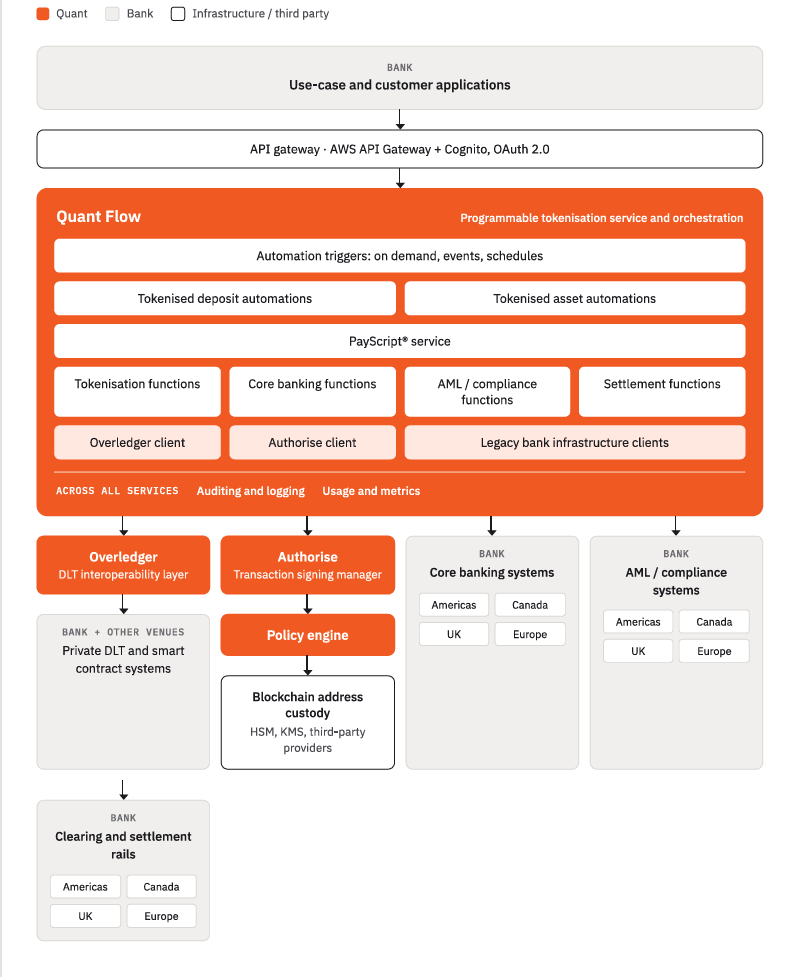
For architects and engineers
Technical architecture retains the detailed service responsibilities, diagrams, transaction states and worked request/response examples. Use Build your integration for the implementation sequence, Recipes for code walkthroughs and the API Reference for request fields and potential responses.
View in API Reference
API Reference
| Operation | Use |
|---|---|
| Submit a token operation | Request an issue, redemption, transfer or lock operation. |
| Get one token operation | Check progress and the confirmed or failed outcome. |
| Get an account's balances | Read the settled total, available and locked positions. |
| Register an account | Prepare a customer's token account. |
| Deploy the token contract for an asset | Set up a supported currency when permitted in your environment. |
| Sign in | Authenticate a named user. |
Related pages
Updated 2 days ago